
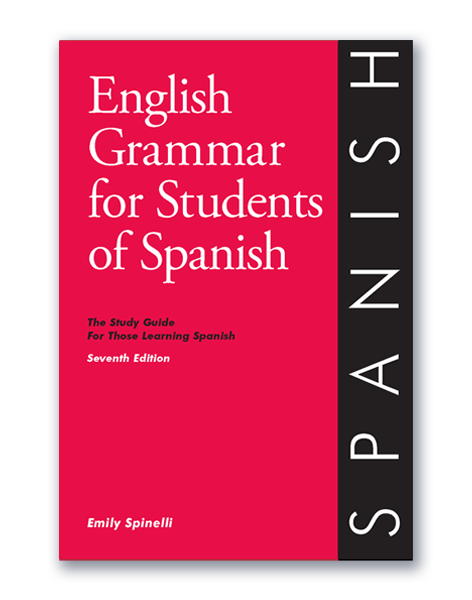
English Grammar for Students of Spanish:
The Study Guide for Those Learning Spanish
7th ed.
ISBN: 978-0-934034-41-8
Pp. 201
$19.95
also on Amazon.com
As an Amazon Associate, we earn from qualifying purchases.
English Grammar for Students in Spanish
Contents
Study Tips
- Tips for learning grammar
- Tips for learning vocabulary
- Tips for learning word forms
- Tips for effective study
- What's in a Word?
- What is a Noun?
- What is Meant by Gender?
- Endings indicating gender
- What is Meant by Number?
- What are Articles?
- Definite articles
- Indefinite articles
- Study Tips — Nouns and their gender
- What is the Possessive?
- What is a Verb?
- What is the Infinitive?
- Consulting the dictionary
- Study Tips — Verbs
- What is a Subject?
- What is a Pronoun?
- What is a Subject Pronoun?
- Choosing the proper form of "you"
- Study Tips — Subject pronouns
- What is a Verb Conjugation?
- Choosing the proper "person"
- How to conjugate a verb
- Study Tips — Verb conjugations
- What are Sentences, Phrases and Clauses?
- Sentences
- Phrases
- Clauses
- Types of sentences
- What are Affirmative and Negative Sentences?
- Negative words
- Negative answers
- What are Declarative and Interrogative Sentences?
- Tag questions
- What are Some Equivalents of "to be"?
- Ser vs. estar
- What is Meant by Tense?
- Study Tip — Tenses
- What is the Present Tense?
- What is the Past Tense?
- The preterite
- The imperfect
- Selection of the preterite or the imperfect
- Study Tips — The preterite
- What are Auxiliary Verbs?
- What is a Participle?
- Present participle
- Past participle
- What are the Progressive Tenses?
- Use of the progressive tenses
- What is the Future Tense?
- Substitute for the future tense
- Study Tips — The future tense
- What are the Perfect Tenses?
- Spanish perfect tenses in the indicative mood
- Spanish perfect tenses in the subjunctive mood
- Study Tips — Perfect tenses
- What is Meant by Mood?
- What is the Subjunctive?
- Study Tips — The subjunctives
- What is the Imperative?
- "You" command in Spanish
- "We" command in Spanish
- Study Tips — The imperative
- What is the Conditional?
- The conditional
- The conditional perfect
- "If-clauses"
- On-going conditions
- Contrary-to-fact statements
- What is Meant by Active and Passive Voice?
- Making an active sentence passive
- Avoiding the passive voice in Spanish
- What is an Adjective?
- What is a Descriptive Adjective?
- Nouns used as adjectives
- Study Tips — Descriptive adjectives
- What is Meant by Comparison of Adjectives?
- Comparative
- Superlative
- What is a Possessive Adjective?
- Spanish unstressed possessive adjectives
- Spanish stressed possessive adjectives
- Study Tips — Possessive adjectives
- What is an Interrogative Adjective?
- What is a Demonstrative Adjective?
- What is an Adverb?
- Study Tips — Adverbs
- What is a Conjunction?
- Study Tips — Conjunctions and the subjunctive
- What is a Preposition?
- Study Tips — Prepositions
- What are Objects?
- Direct object
- Indirect object
- Sentences with a direct and an indirect object
- Object of a preposition
- Relationship of a verb to its object
- What are Direct Object Pronouns?
- Study Tips — Direct object pronouns
- What are Indirect Object Pronouns?
- Spanish use of indirect object pronouns
in place of subject pronouns - Study Tips — Indirect object pronouns
- Spanish use of indirect object pronouns
- What are Object of Preposition Pronouns?
- Study Tips — Object of preposition pronouns
- What are Reflexive Pronouns and Verbs?
- Reciprocal action
- What is a Possessive Pronoun?
- Study Tips — Possessive pronouns
- What is an Interrogative Pronoun?
- "Who, whom, whose"
- Dangling prepositions
- "What"
- "Which one, which ones"
- "How much, how many"
- Study Tips — Interrogative pronouns
- What is a Demonstrative Pronoun?
- Spanish neuter demonstrative pronouns
- What is a Relative Pronoun?
- Subject in a relative clause
- Direct object in a relative clause
- Indirect object and object of a preposition
in a relative clause - Relative pronouns without antecedents
- What are Indefinites and Negatives?
- Study Tips — Indefinites and negatives
Index
“Excellent book!! Provides students with the essentials of their own native grammar necessary to comprehend the similarities and differences between English and Spanish.”
— Linda Q. Sites,
Virginia Commonwealth University
Virginia Commonwealth University
You’ll use English Grammar for Students of Spanish
- to prepare for class by reading the relevant pages
- to consult for extra help when doing homework
- to review English and Spanish grammar before exams